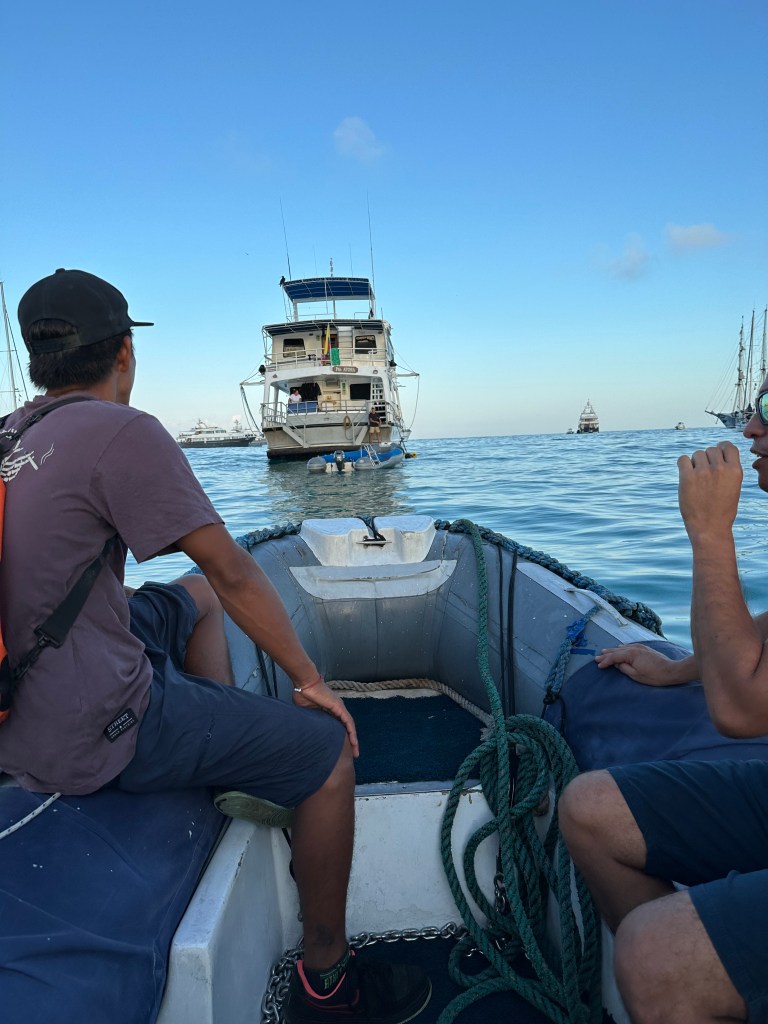
“Hola, Capitano!” I screamed with exertion over the lapping ocean. The swarthy Ecuadorian straightened and grinned hugely, making a heart shape with his two immense hands. It was a special moment, and even though we had many witnesses, I kept my smile inside, lingering with it like one would a secret love note.
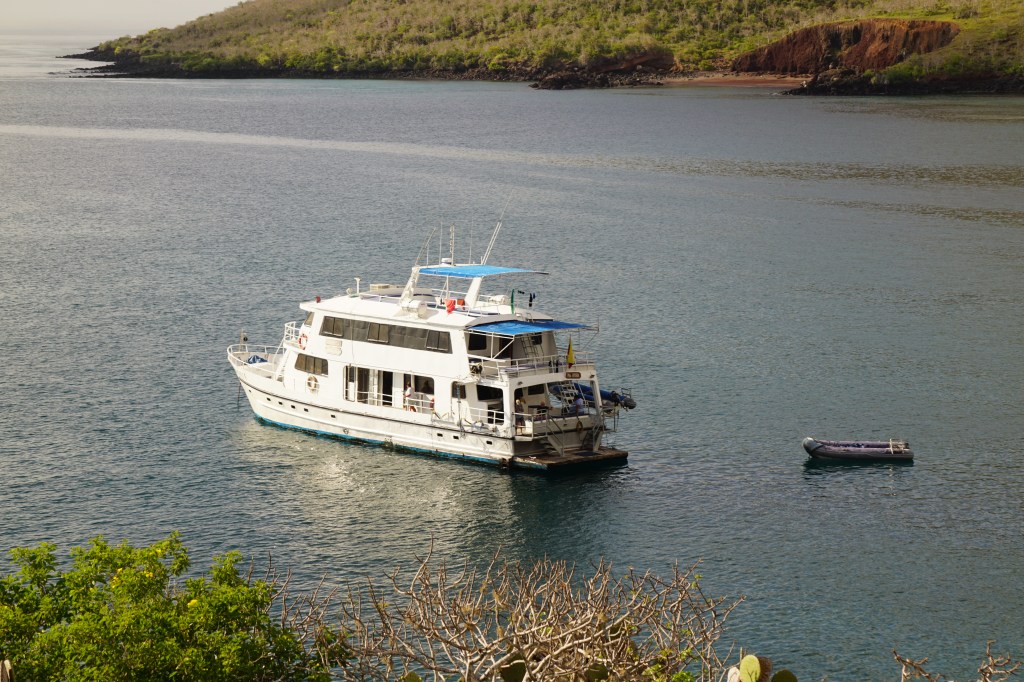
We had stayed for a few nights on his rustic, recognizable boat, the boringly-named Fragata, just a day or two before, rising freakishly early and eating unmemorable food with the crew, helping to tidy, venturing daily to excursions with Jorge, whom I now spied snorkeling with new clients. He barely looked up when I called, but the captain’s love — continuing in the form of his hand-hearts as we drifted far into the distance — overshadowed Jorge’s replacement of us so soon, which otherwise might have seemed a slight. We were no longer the audience for his dad jokes.
Jimmy, too, was visible on the Fragata from the deck of our daytrip boat. Poor Jimmy. We knew it had to be a made-up name, but besides that, he was enormous. For someone whose exclusive responsibility was to shuttle passengers to and from the larger boat in a panga tilted deeply at one end under his weight, he took up a big (no pun intended) part of our experience, barely speaking (in any language) and barely moving from his capsizing corner. When he did speak, it was mostly to the captain, and what’s more, in a high-pitched voice that most certainly did not match his body.
Our visit to the Galapagos Islands had begun immediately upon setting feet on the ground. Aidan hadn’t walked off a plane into hot open air before, that he remembered, at least. His enjoyment of that, and all the creatures seemingly greeting us at the airport and in the town square of Santa Cruz where we spent our first night, made the experience even more indelible. Sea lions and other animals gathered around like old drinking chums; it was practically a scene out of South American Snow White or another Disney movie in which animals interact comfortably with humans. We left Santa Cruz to sojourn on the small cruise boat, as everything online and from conversations with wealthy, Galapagos-savvy friends had suggested it a necessary expense to visit the Islands. The twin beds in my room with Mike were hardly more than cots; I could touch my knees to the door in the head when I sat down. Due to our aft location, everything that went on outside, we were the firsts to know about it. Meanwhile, Aidan had his own room with two twin beds, sunbeams streaming in from quiet midship where there was no walkway.
One night they told us we’d be parking for a bit on the water and turning the lights on to “feed the pelicans,” i.e., watch birds dive to eat as fish approach the boat, both birds and fish drawn to the rare nighttime luminescence. I looked out the window for a bit, wondering where Mike and Aidan were, and finally decided I didn’t want to wait for them. I leaned forward on the upper back deck and watched, mesmerized, as various fish, large and small, came to check us out. Indeed, pelicans and other seabirds waited, side-eyed and ready.
During the days, we’d been swimming with myriad sharks, playful sea lions, lumbering turtles, various rays, and penguins. Even after a hundred Galapagos adventures in my wildest imaginings, I could never be blasé about catching movement from the corner of my eye and turning to see a penguin speed-swim past me, flying in the ocean — or glancing down to come eye-to-eye with a sea lion twisting underneath the length of my person and upward to play tag, unarguably a smile dancing on her lips. These experiences notwithstanding, I was thrilled to take in the illuminated aquatic creatures in relative silence, until I sensed a presence on the deck beside me. There was the captain, who had a warmth that vibrated from him in the light breeze.
“Todo bien?” he asked. We had already established that our communication would be thus limited and seemed to make up for it with gestures and eyebrows. This same conversation had already taken place and was to be repeated several times more in the few days we were on his ship.
“Si, si, gracias. Todo muy bien.” He asked where my family was. I pointed up because I thought they were on the little roof of the ship, then I made a “but who knows?” gesture. There were only six non-crew on the boat, so the possibilities were extremely limited, and at the moment I was content to be unaware and (somewhat) alone. He stayed there, looking out. Was he smoking a cigar? I can’t remember. I also don’t know if he spoke after that, but it was as if he was flirting with his skin. The warmth I’d felt continued to emanate from him.
Suddenly, a giant shark swam by, definitely a kind you wouldn’t want to swim with. I murmured in awe. Most everything was silent, except for a couple of birds that flapped away, and maybe a few high peeps from Jimmy.
El Capitano swaggered back to his quarters.
As much as I loved the Fragata and its weird little commune, staying on a boat to cruise the Galapagos is prohibitively expensive, even with our selected company as one of the more affordable overnight options. Knowing now what I didn’t all the years I dreamed of visiting the islands, I would probably opt next time for staying on the demure Isabela, with its few cute, tiny b&b-style hotels and stunning wide expanse of white sand beaches — then venturing to Bartolomé and the other diverse islands on guided day trips. Looking for wild goats, ponds of flamingoes, or volcanic landscapes? They’ve got ‘em. Is snorkeling more your speed? As mentioned, there is much to see under the surface. Santa Cruz does have the educational Darwin Center, plenty of good hotels and restaurants, memorable beaches, and a stunning hike-through preserve, but it is overpopulated (while not swarming with people). These islands were not meant to ever be lived upon by humans. As though foretelling your inevitable boat experience, Santa Cruz will not allow you to flush toilet paper anywhere on its body.
The trip, even for a small family of three, was the kind you must save for, for years and years. In fact, we had. While it was a drop in the proverbial bucket of the overall expense, when Aidan was five, I had created a “Galapagos fund” (and a life lesson) from found coins on the street. I could be wrong, but I doubt any middle-income family or even individual of the future will be able to comfortably afford to visit without a great deal of financial sacrifice and austerity. We ended up with debt afterwards, even in a higher income bracket as we are.
All things considered, I wouldn’t change my “air hearts,” broken conversations, or the strange intimacy I experienced, with man, boat, and nature, for anything in the world.
 The Optimistic Traveller
Leave a comment