We had driven from Maputo, Mozambique where we were working together on a visit by former President Clinton to meet with officials on his AIDS initiative and tour a medical facility. George and I meshed well. As the Lead and much more experienced than I was at this type of international event planning, he was a kind and reasonable person and confident enough not to micromanage. He allowed me to handle certain parts exclusively, and it showed, because I, too, am great at this work. The visit went beautifully.
My allergies in Africa are in a class by themselves. On a previous visit to the continent, a driver had picked me up for a safari only to, upon sight of my basketball-like countenance, take me straight to an urgent care clinic. (In small African villages, clinics are huts or concrete open-air porticos with dirt floors.) Having spent most nights in George’s bed, I also hadn’t slept much, as his snores could wake the comatose. I truly hope, for his own health and longevity, he has since dealt with that extreme blood-curdling sleep apnea; if I close my eyes I can still hear the roar. In any event, we arrived at dusk, me puffy and exhausted, at the edge of Kruger National Park in South Africa. In checking into the sparse room and looking out from its balcony, we were intrigued to spy a half-eaten carcass below. It was relatively fresh, because we couldn’t smell a thing in the warm, breezy night.
I woke before dawn’s full beam, the aforementioned woodsaws rousing me in these, the days before I owned noise cancelling earbuds. Stepping outside, I heard quieter sounds below and looked down to the spot where we’d seen the carcass. Sure enough, a lioness was feeding, gentle rips and crunches as she tenderly focused. It was a shock, because I didn’t know that lions might feed on carrion like hyenas or vultures – but it occurred that maybe it was her kill and she’d been thwarted from finishing her meal upon our arrival the night before.
I whispered urgently to George, because it had to be shared, even in its gruesomeness. It reminded me of the time when I was 14 and a guest of Lidia’s grandmother’s in Orlando, Florida. I had never “tanned” before and was as white and delicate as a dying Victorian. When we came out of the sun and I removed my suit in the bathroom, I burst into wild laughter at the ridiculous sight in the mirror. It was as though I were a red person wearing a juvenile nude-print bikini, complete with a tiny amount of pubic hair and burgeoning breasts. I screamed, guffawing in between, and demanded her to come look. (Thus began a lifetime of exhibitionism. Not really, but sort of.) My point is, these things need waking up for. You don’t get to keep them to yourself.
This is why one stays as close as possible to or in the park when going on safari – because you can truly sneak up on nature in its splendor and horror. I have been on two other day-safaris in Tanzania without staying nearby, and while I saw every African animal (under the sun) doing everything from feeding to…mating, nothing compared to this utterly mesmerizing sight.
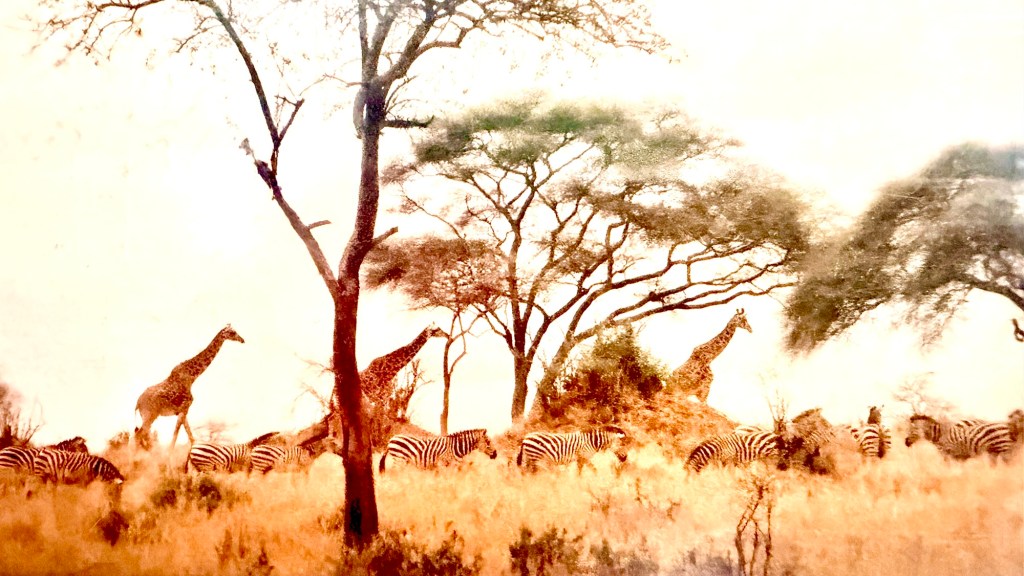
The earlier safaris were also altering experiences, if not as thrilling in the spy-sense. Tanganyika National Park and the Ngorongoro Crater are both incredible destinations (and can be done in the same trip with a flight into Arusha, Tanzania). In the former, we were frighteningly close to riled-up elephants who will most certainly charge if so inclined, and to languid lions in various stages of coital bliss. Admittedly, I was most amazed by some of the more stationary life forms there. The baobab tree, or as I prefer to think of it, this ancient being, also known as the Tree of Life — that had seen myriad creatures come and go in its long lifetime – was an object of fascination. A baobab can live for 5000 years (and counting) and is a source of nutrients (Vitamin C in its fruit, other vitamins in its seed oil, used for skin and hair) and an ecosystem to many organisms. Rope is also made from its bark, and it will then say, “alrighty then,” and carry on living, possibly stronger than before. To witness baobabs at all is to witness aliens who understand so much more than we do, even as we desperately try to put our collective finger on their longevity secret. I have been since forevermore boggled.
To the Ngorongoro, I went with Mussika, a modern Maasai. (He didn’t wear the traditional robed attire and lived with his family in a small house, not as a nomad like the more traditional tribespeople do.) As you head down into the steep crater, you catch your breath. You might miss seeing giraffes — but just get your fill in Tanganyika and you’ll be fine. (Giraffes can’t make it down the 600-meter walls of the crater.) The volcanic caldera which formed two to three million years ago is the largest “inactive, intact, and unfilled” volcano in the entire world, and it is home to a shameful exorbitance of biodiversity. Ok, perhaps “shameful” is not exactly right, but Ngorongoro, you’re hogging! (And that IS a shame for people who don’t have the extreme privilege to visit.)
Ngorongoro, one of the best proper names in existence to perfect pronouncing, was ripe with monkeys on the outskirts, and hyenas on the inside. It was a veritable smorgasbord of animals, but those two categories – and leopards — particularly stand out from my journey there, though possibly because I hadn’t seen them in Tanganyika. I learned that spotted hyenas are good hunters; it’s just that, hey, if it’s already dead, might as well take an easy score, and I am fully down with that sensibility. Mussika, despite the reputation of his tribe, was not particularly knowledgeable about the majority of animals we observed, other than in semi-identifying them. I took a lot of pictures with a camera that used real film and enjoyed a mostly silent if dusty reverie on my good fortune at having decided to make this trek on my own, trusting him to keep my small female self safe, if not allergen-free. To save the gas I’d paid for, he wouldn’t turn on the air conditioning, so the windows were wide-open, and I thus probably wouldn’t have registered at all on an oximeter. The adventure, despite my practically nonexistent breathing capacity from the outside pollens and brickish dirt his truck was throwing up, restored my faith in humanity, to a degree that has only begun to fade in recent years.
At Kruger, as a sliding switch began to reveal the sun’s ascent, George groggily stepped to the balcony, and we watched together in silence, the details refining before our eyes. Eventually, the lioness loped off, and we went on our safari, and saw monkeys, zebras, giraffes – the usual majestic fare – as well as the possibility of a lasting love together. And, after all, possibility is so much more valuable than reality (almost) all of the time.


Leave a Reply